EMBO | EMBL Symposium - Organoids: modelling organ development and disease in 3D

Register
Register
Date & Time
2025 年 10 月 22 日至 25 日
Location
德国海德堡
Tags
Organoids

EMBO | EMBL 研讨会:类器官发育和疾病三维建模汇集了领先的研究人员,讨论类器官生成和应用的最新进展。本次活动重点介绍了类器官系统如何改变我们对组织发育、疾病机制和再生医学的理解。

2025年版将探索该领域的新前沿,整合多组学、生物工程和工程胚胎模型等互补技术,并将重点更多地放在与癌症相关的类器官研究上。

MaxWell Biosystems很高兴能参加展位、海报、讲座和研讨会。访问我们,了解我们的高密度微电极阵列 (HD-MEA) 技术如何实现类器官和三维培养物的详细功能读数。我们的团队将很乐意讨论您的样本和应用,并帮助您确定最佳的研究方法。

加入我们在海德堡的行列,交流思想,探索电生理学如何为复杂的类器官系统带来新的见解。

Meet the MxW Team

No items found.

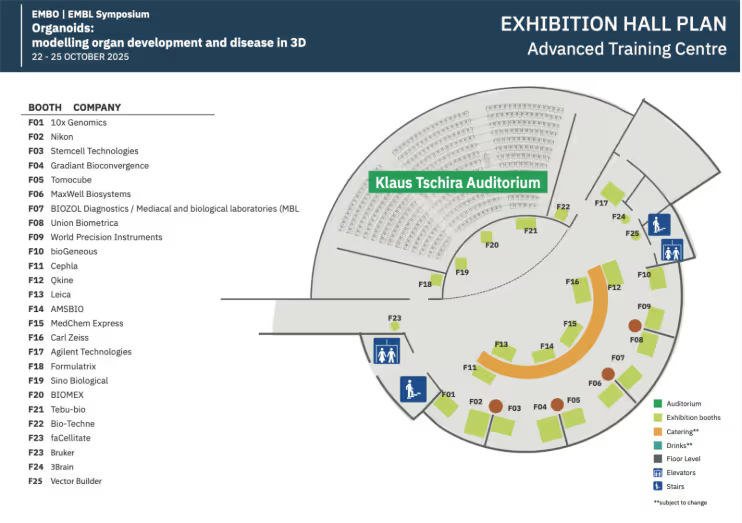
MxW Booth

欢迎来到 #3130 号展位找我们:来亲自与我们见面,探索新增内容!
No items found.

Poster 
Presentations

2025 年 10 月 24 日星期五 | 16:30-18:30 | 海报 #228

用于人类神经类器官和组装体功能表征的下一代电生理学

Abstract

人类诱导多能干细胞(HipSC)衍生的三维神经模型,例如类器官和组装,已成为模仿人脑发育关键方面的重要工具。这些自组织 体外 系统为包括阿尔茨海默氏症和帕金森氏症在内的神经退行性疾病的研究做出了重大贡献。对电活动进行实时、无标记的监测对于分析这些模型中神经元网络的复杂行为至关重要。

高密度微电极阵列 (HD-MEAs) 为高分辨率电气成像提供了强大的非侵入性平台,可以实时记录从神经类器官和组装物到大脑和视网膜组织切片等各种电生样本。在这项研究中,我们使用了MaxOne和MaxTwo HD-MEA系统,每个系统均具有26,400个电极,以多种分辨率从三维神经模型中捕获细胞外动作电位,从亚细胞隔室和单细胞到整个网络。这些平台灵活的电极选择能力有助于提高数据的可重复性和统计稳定性。分析了射速、尖峰振幅和网络爆发特性等关键参数。为了更深入地了解亚细胞过程,AxonTracking Assay被用来绘制沿轴突分支的动作电位传播图,从而可以详细检查轴突特性,例如传导速度、潜伏、长度和分支模式。

这些 HD-MEA 平台有选择地靶向电极的能力提高了数据质量,同时提高了可重复性。结合用于自动数据可视化和指标提取的集成工具,此处介绍的系统提供了一个强大、用户友好的平台,支持疾病建模和药物测试中的急性和长期电生理学研究。

Biography

Workshops

Wednesday, October 22, 2025 | 12:00 -13:00
Modeling Alzheimer’s Disease in Cerebral Organoids: From Amyloid β Accumulation to APOE4-Specific Drug Responses

Alzheimer’s disease (AD) is characterized by progressive neurodegeneration, amyloid pathology, and limited treatment options. Conventional models fail to fully capture the complexity of human-specific mechanisms, prompting the development of cerebral organoids derived from induced pluripotent stem cells (iPSCs) as disease-relevant platforms. We thus established AD organoid models capable of recapitulating hallmark features of pathology, including extracellular amyloid β (Aβ) cluster formation and elevated levels of Aβ peptides detectable in culture media. Using organoids carrying familial AD mutations in PSEN1, single-cell RNA sequencing revealed accelerated neuronal differentiation, consistent with previously reported hyperexcitability phenotypes in AD models. We further extended our work by initiating a single-cell sequencing atlas of AD cerebral organoids, enabling detailed characterization of disease-associated transcriptional programs. Importantly, we show that AD pathology can be reproduced across multiple genetic backgrounds, including SORL1 variants. Lastly, beyond modeling, we employed organoids for therapeutic testing and demonstrated that Tramiprosate exerts selective effects on APOE4 organoids, altering lipid metabolism, while leaving APOE3 organoids largely unaffected. Our findings thus highlight cerebral organoids as a robust platform for modeling genetic risk factors, dissecting molecular mechanisms of AD, and evaluating genotype-specific drug responses. This approach bridges the gap between fundamental research and translational applications, advancing our understanding of Alzheimer’s disease at the single-cell level.

Register

Which activities are you attending?

You can unsubscribe from marketing emails at any time. For details, see our Privacy Policy.

Submit
谢谢!您提交的内容已收到!
哎哟!提交表单时出了点问题。
MaxWell