ISSCR 2026

Register
Register
Date & Time
8-11 July, 2026
Location
Montréal, Canada
Tags
Neuronal Cell Cultures
Organoids
Functional Phenotyping
Disease Modeling
Pharmacology & Toxicology

ISSCR 2026 is one of the landmark annual meetings in stem cell research, bringing together the global community to share breakthroughs, exchange ideas, and explore the latest advances across the field. Covering topics from basic stem cell biology to disease modeling, drug discovery, engineering, and clinical translation, it is a key meeting for staying close to where stem cell research is heading.

As every year, we are excited to be there, connecting with the community, discussing new ideas, and support your research and next discovery. Join us at our booth, innovation showcase, and posters to discover how next-generation HD-MEA technology brings functional insights to stem cell research, and learn what's new in the field.

Meet the MxW Team

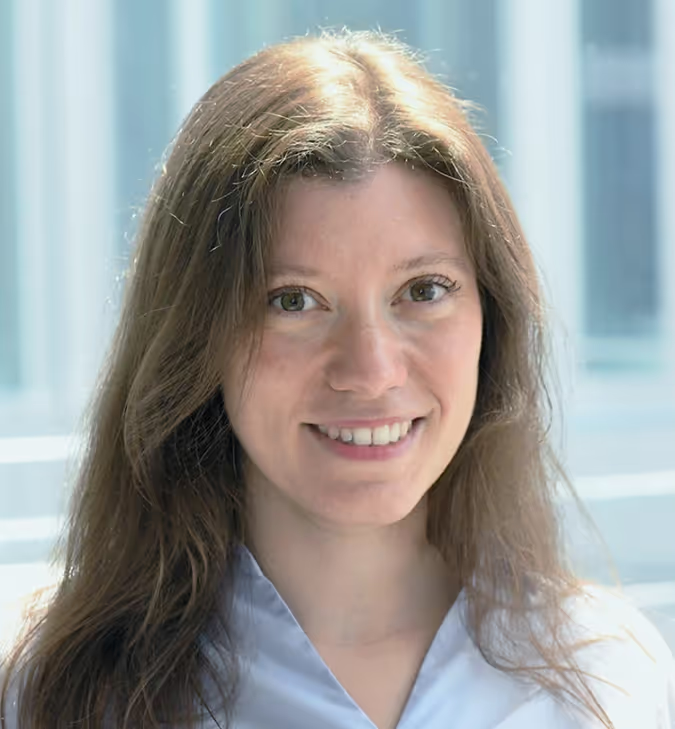
Dr. Francesca Puppo

Field Application Scientist | MaxWell Biosystems (Switzerland)

Dr. Laura D'Ignazio

Head of Commercial Excellence and Engagement | MaxWell Biosystems (Switzerland)

Dr. Marian Hruska-Plochan

Scientific Business Developer | MaxWell Biosystems (Switzerland)

Dr. Silvia Oldani

Head of NAM | MaxWell Biosystems (Switzerland)

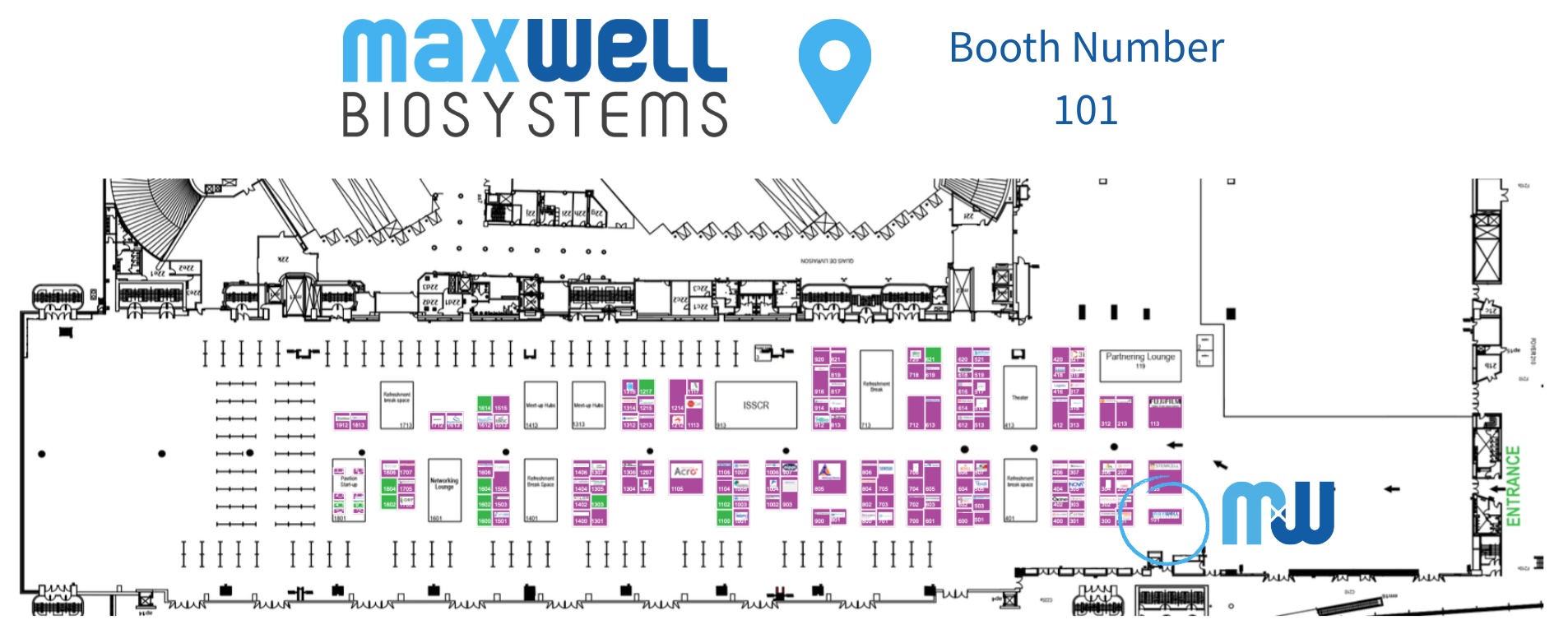
MxW Booth

Come Visit us at our booth! More information coming soon...!

No items found.

Poster 
Presentations

Dr. Francesca Puppo

Field Application Scientist | MaxWell Biosystems (Switzerland)

TBD

A multiscale HD-MEA workflow to quantify network, excitability, and propagation phenotypes in midbrain organoids

Abstract

Human iPSC-derived midbrain organoids are emerging as 3D models to study dopaminergic neuron development and dysfunction in midbrain-associated disorders, including Parkinson’s disease (PD) and related synucleinopathies. In these conditions, phenotypes can manifest as progressive shifts in excitability, network dynamics, and signal propagation, potentially preceding overt neurodegeneration. However, electrophysiological assays for organoids must combine throughput, longitudinal stability, and high spatial resolution to detect subtle functional changes during maturation and in response to compounds with therapeutic potential. Here, we present a reproducible, high-throughput multiscale functional profiling workflow for human iPSC-derived midbrain organoids using High-Density Microelectrode Arrays (HD-MEAs).

In collaboration with STEMCELL Technologies, we plated midbrain organoids at an early functional stage (organoid age ~77 days) onto MaxWell MaxTwo 24-well HD-MEA plates (26,400electrodes/well) and tracked electrophysiological development longitudinally for~1 month. Using the ActivityScan assay, we quantified progressive strengthening of spontaneous activity, including increased firing rate and spike amplitude, consistent with functional maturation. Using the Network assay, organoids showed increasingly organized dynamics, with synchronized bursting emerging and becoming more robust over time, accompanied by increased burst cadence. To establish responsiveness for compound workflows, we applied 4-aminopyridine (4-AP) and tetrodotoxin (TTX), which induced rapid and reproducible bidirectional modulation of firing activity, supporting suitability for pharmacological testing and screening. Furthermore, using our unique AxonTracking assay, we extracted label-free soma-to-axon propagation patterns at the organoid–electrode interface, enabling subcellular-resolution phenotyping complementary to network metrics.

Together, these results demonstrate a scalable HD-MEA workflow for longitudinal, multiscale functional phenotyping of midbrain organoids, supporting assay development and pharmacological perturbation studies in 3D human iPSC-derived models for neurodegenerative disease–relevant phenotyping and screening.

Biography

Dr. Marian Hruska-Plochan

Scientific Business Developer | MaxWell Biosystems (Switzerland)

TBD

High-Density Microelectrode Arrays (HD-MEAs) for modeling, phenotyping, and screening in a human model of frontotemporal dementia

Abstract

Frontotemporal dementia (FTD) due to progranulin (GRN) haploinsufficiency shows evidence of early alterations in functional connectivity, but translating human iPSC-derived models into quantitative, mechanistically anchored functional endpoints for therapeutic development remains a critical challenge. Detecting subtle and progressive functional disease phenotypes requires sensitive, scalable, and longitudinal electrophysiological readouts. The MaxTwo Multiwell High-Density Microelectrode Array (HD-MEA) System (MaxWell Biosystems, 26,400 electrodes per well; 17.5 µm pitch) was used to record real-time, label-free functional activity from FUJIFILM Cellular Dynamics iPSC-derived iCell Induced Excitatory Neurons co-cultured with apparently healthy normal  iCell Astrocytes 2.0, comparing apparently healthy normal control neurons to a GRN R493X heterozygous knockout neuronal FTD model over 6 weeks in vitro. In the progranulin haploinsufficiency neuronal FTD model, increased excitability was evident at early developmental stages with significantly elevated mean firing rates and reduced inter-spike intervals by DIV 15 (p < 0.01) and persistent hyperactivity throughout maturation. Sustained network dysfunction and irregular oscillation patterns were observed, including increased burst frequency from DIV 25 and >2-fold prolonged burst durations by DIV 50 (p < 0.001), consistent with impaired network consolidation.  The AxonTracking Assay revealed a distinct subcellular phenotype: despite hyperexcitability, the FTD model exhibited reduced axonal branching and shorter neurites, reflecting impaired connectivity.  High-density electrode coverage and superior signal-to-noise enabled reconstruction of action potential propagation along individual axonal arbors, revealing structure-function deficits not detectable with conventional MEAs.

Overall, longitudinal profiling on the MaxTwo HD-MEA platform provides a sensitive, reproducible, and scalable approach for multi-parametric electrophysiological phenotyping in human iPSC-derived FTD models. By resolving network-, cellular-, and subcellular-level dysfunction within a unified assay framework, this platform delivers robust, mechanistically informed functional endpoints suitable for pharmacological perturbation and phenotypic drug discovery in FTD and other neurodegenerative diseases.

Biography

Workshops

No items found.

Register

Which activities are you attending?

You can unsubscribe from marketing emails at any time. For details, see our Privacy Policy.

Submit
Thank you! Your submission has been received!
Oops! Something went wrong while submitting the form.
MaxWell