Brain Organoid Reservoir Computing on MaxOne HD-MEA
Date
Type
Tags
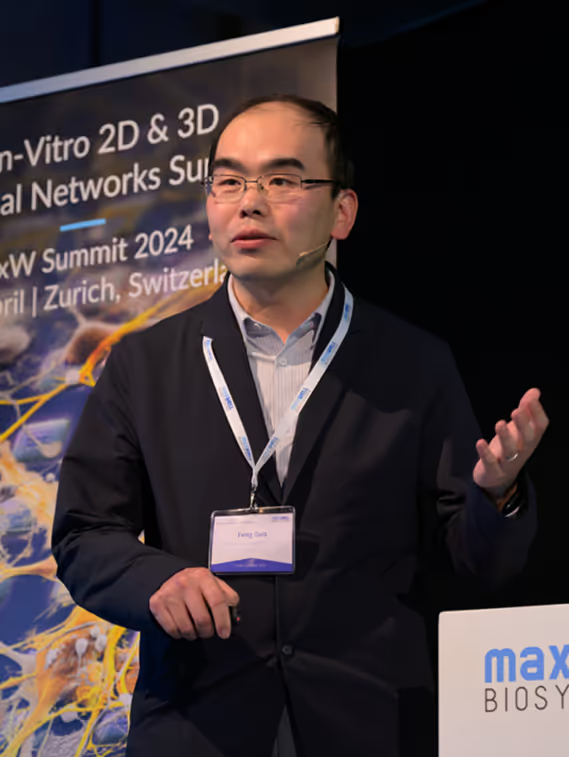
“If you have one electrode covered by many neurons, you acquire average information, which is not enough for specific computing conditions. What we really aim is high resolution at a single-neuron level, something we can achieve with MaxOne HD-MEA.”
Back in April, we had the pleasure of having Dr. Feng Guo as a keynote speaker at the 4th In-Vitro 2D & 3D Neuronal Networks Summit, where he captivated the audience with insights into neural networks and artificial intelligence (AI). More recently, he joined MaxWell Biosystems Innovation Showcase at ISSCR 2024. Dr. Feng Guo shared his work using the MaxOne high-density microelectrode arrays (HD-MEA) system and what the future holds in the neuroengineering research field.
We took the opportunity to engage in an inspiring conversation with Dr. Feng Guo about the exciting publication by Cai et al. in Nature Electronics, entitled “Brain organoid reservoir computing for artificial intelligence”, work he led. The study demonstrates that brain organoids can be combined with HD-MEAs and AI computing, and can carry out different computational tasks. Their hybrid system can process, learn, and remember information, and we were delighted to further discuss with Dr. Feng Guo this new chapter for biocomputing.
In this
conversation
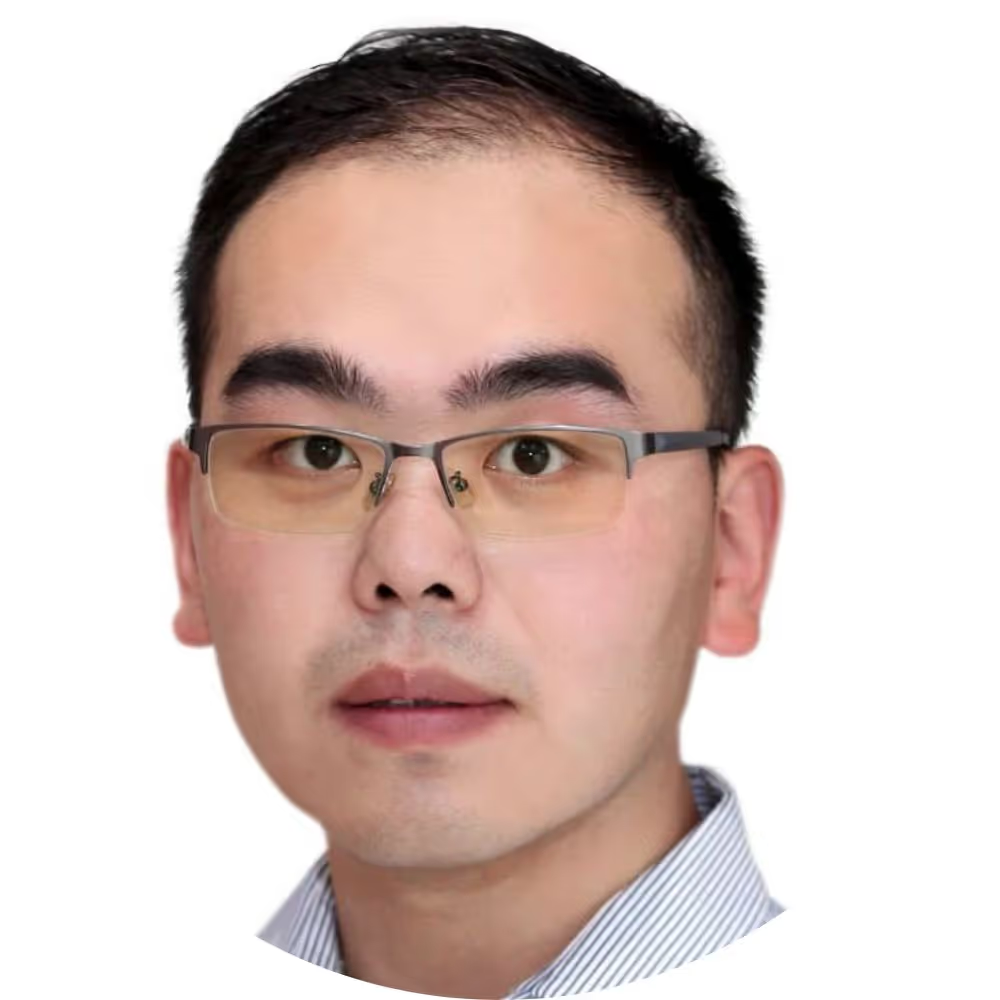

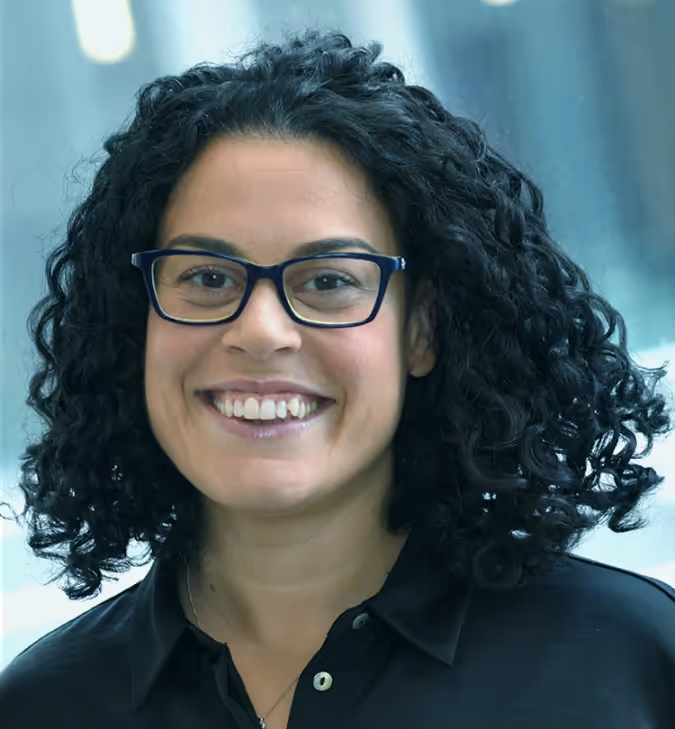
Laura: Hello Dr. Feng Guo! Thank you for accepting our invitation for this interview. We are excited to be speaking with you today about your publication in Nature Electronics featuring Brainoware!
Thank you for the invitation. It is a pleasure for me to be speaking with you today about this project!
Laura: I am really fascinated by Brainoware and its ability to send and receive information from the brain organoids using the MaxWell Biosystems HD-MEA. Could you share with us more details on how this information is exchanged?
Initially, we began with an online database, transforming its data into spatiotemporal stimulation patterns through many optimizations. Next, we put those electrical stimulation through MaxOne HD-MEA chips. Electrode selection was done by scanning the activity of tiled blocks of 1’020 active electrodes, grouping into 32 different areas and regions. This enabled us to deliver encoded information to the organoids via the selected electrodes. Within miliseconds after the stimulation, we received the organoid response in an electrical signal format. It took us roughly half a year to optimatize this process.
Marie: Uau, only six months, that is impressive! Since the activity of an organoid is quite complex, I have a follow up question. In the paper, one of the key findings is that the organoids could carry out computational tasks. How were you able to make sense of the complicated signals from the organoids and identify that they were learning the task? What was the criteria that made you say “yes, the organoid is learning”?
Before claiming the learning capability, we checked for functional connectivity and, using the MaxOne HD-MEA system, we observed a gradual increase in the functional activity over time. This was confirmed by the emergence of new connections through synapses, indicating that we were getting better and better neural networks within the organoids. Consequently, we revisited the training process and found increasing accuracy during the training.
Laura: Following up on that, in the study, the organoids were able to do speech recognition and non-linear equation prediction tasks, which is amazing! What other complex tasks do you think can be applied?
We aimed to demonstrate the capability for spatial and temporal information processing. Now, we are thinking about how to combine both temporal and spatial information processing to tackle complex real world information. How can we effectively handle dynamic information from the real world? That is a question we are currently considering and something we plan to explore in the near future.
Laura: Thank you Dr. Feng Guo. While reading the paper, I also got intrigued – why did you use organoids for Brainoware, instead of, for example, cell cultures or other cell models?
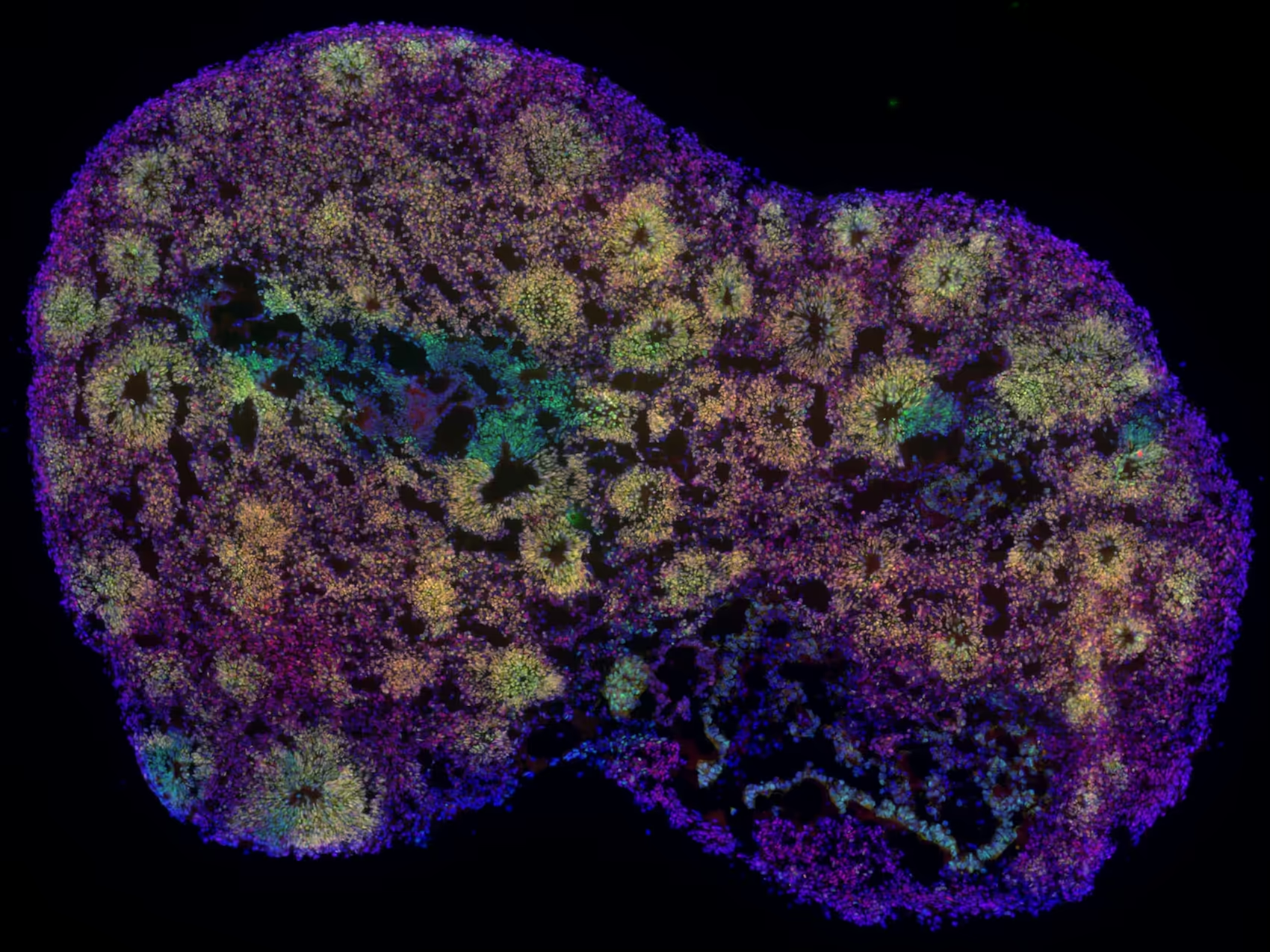
Organoids contain diverse cell types, such as neurons, astrocytes, and neural progenitor cells, offering a complexity closer to that of the human brain. While I believe our work could also be done with 2D models, in my point of view, organoids are better suited for learning – particularly for adaptive learning.
Marie: Another curiosity!What is a good age for the organoid to start learning?
We chose organoids aged between 2 to 3 months since there are already enough mature neurons at this age to start our experiments. However, further exploration to determine the optimal age are definitely needed.
.avif)
Marie: Thank you Dr. Feng Guo.And how did you overcome the variability from organoid to organoid?
There are region-specific organoids. The variation in midbrain organoids is lower, while cortical organoids exhibit higher variation. Therefore, we selected both types for many of our experiments. However, as you mentioned, we still observe variations from batch to batch. We are putting effort into achieving better control of the differentiation protocol, microenvironment. etc.
Marie: Interesting, thank you.Since you talked about future earlier, could you tell us a bit more what the future plans are for your research?
Thank you for the question! Yes, we aim to explore how we can further improve an organized computing system for real world information, as mentioned before. And coming back to MaxWell Biosystems HD-MEA, we want to use your technology to establish a system capable of supporting organoids for a very long time for recording and computing towards real-world applications.
Marie: We are eagerly looking forward to following up on the progress! As a follow-up, I have a another question. You mentioned that the interface with the MaxOne HD-MEA system helped you to achieve a successful communication with the organoid so that it could learn the tasks. What are the features that allowed you to reach this goal?
Well, there were two things. One is the high density of electrodes. The second is that MaxOne provides electrical stimulation through individual manipulation of those electrodes. This was critical for our work, so I think those are two features that are super important for our application.
Marie: Could you elaborate a bit more on how the high resolution helped you?How did it provide advantages compared to having less electrodes?
Coming back to our earlier discussion, we encounter organoid-to-organoid variation. Therefore, if you have one electrode covered by many neurons, you acquire average information, which is not enough for specific computing conditions. What we really aim is high resolution at a single-neuron level, something we can achieve with MaxOne HD-MEA.
Marie: Thank you for your answer. It is very exciting to see this combination that overcomes variability by having many electrodes, thereby enabling the detection of signals with higher quality data. Moreover, being able to use this data for computing adds another level of potential!
Yes, we are lucky to have MaxWell Biosystems making our research possible.
Laura: Thank you Dr. Feng Guo. Could you please share what the biggest challenge was for you in this project?
The challenge did not really arise from the interface but rather from the organoid itself. It is not easy to capture and maintain numerous organoids over a long period of time for this type of bio-computing work. It brings to mind our previous discussion on how to maintain organoids long-term for a stable bio-computing approach.
Laura: Thank you for sharing!What was that eureka or aha! moment you and your lab had while doing this project?
With the support of MaxWell Biosystems, we were able to demonstrate the combination of the HD-MEA with the organoid. The aha! moment occurred when we first leveraged the biological neural network within the organoid for AI computing. This breakthrough offers potential solutions to current AI hardware challenges, and we are incredibly excited about this opportunity.
Laura: Slightly changing the topic now. Dr. Feng Guo, we were extremely happy to have you as a keynote speaker at the MxW Summit this year! As you might have noticed, our event attendees spanned through different academic levels, so we would love to learn more about your journey as a Principal Investigator. Do you have any advice that you always share with your lab and would like to share with this audience?
Research work is challenging, but my curiosity drove to where I am today. In my lab, I often engage in conversations with my students to understand whether or not they like their project or maybe would like to pursue other ideas of their own. I believe that when students are driven and motivated by something, they can be very successful. Personally, I feel very lucky. I love doing research and my job lets me do that all the time. I am very happy about it.
Marie: Thank you for sharing these kind words.To finalize our conversation and shift away from the lab, what is your favorite hobbie?
I am a big fan of fishing, both lake and sea fishing. In Bloomington, they have Lake Monroe not too far from my house, and I go there often. Each season brings different types of fish. I have a kayak and I go fishing myself, enjoying the weather and some quiet time for thinking.
Marie: That’s amazing.You are fishing the next ideas for your lab!
Laura: This brings us to the end of our conversation. Thank you, Dr. Feng Guo, for such an insightful and inspiring discussion. I am sure all readers, like ourselves, will be eagerly looking forward to what comes next in your research!
I really enjoyed the conversation, thank you so much. And see you next time!
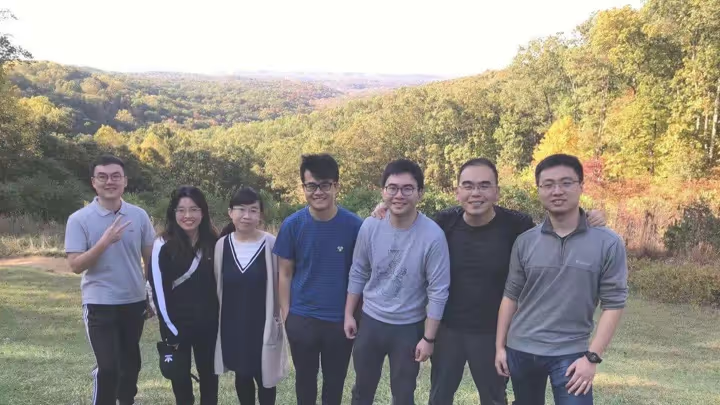
Thank You
We would very much like to thank Dr. Feng Guo for making time in his busy schedule for this interview. We are very appreciative of this inspiring conversation we had with him!
Discover More
If you would like to know more about the recent publication from Prof. Feng Guo’s lab, please click the button below.
Related Resources
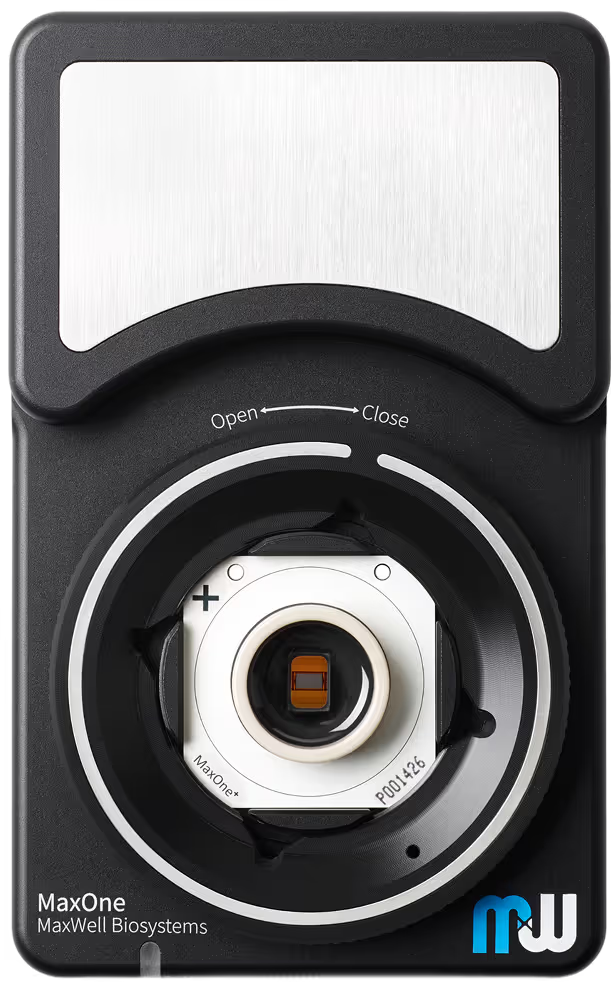
MaxOne
Versatility and functionality in one compact device
Our Technology
Multi-/Micro-electrode Arrays
Biocomputing
Organoids
Neuronal Cell Cultures
Brain organoid reservoir computing for artificial intelligence
